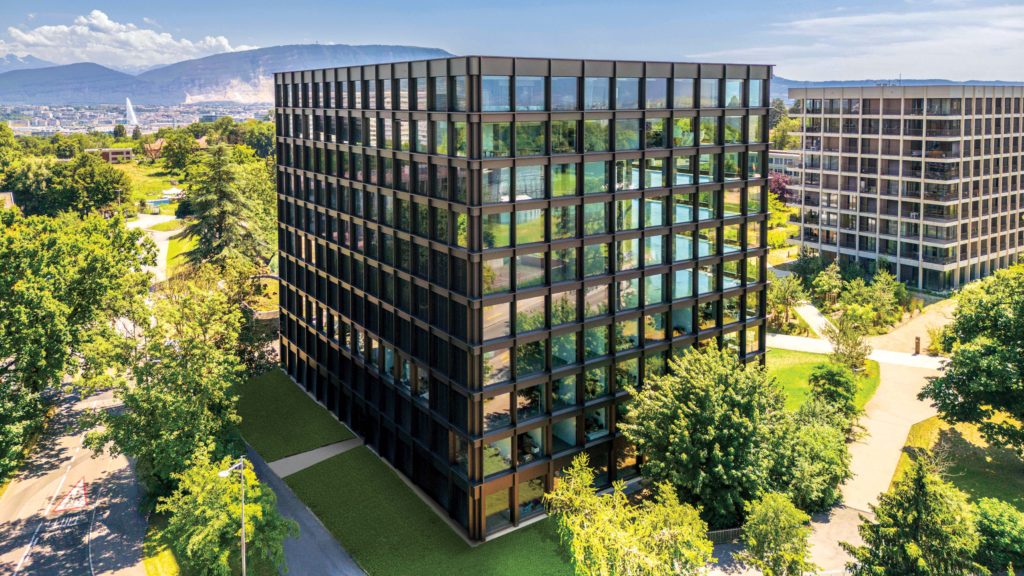
Kyoto, a building designed for tenant well-being and environmental performance
What kind of experience did you want to offer tenants with the Kyoto building, and how was this reflected in its design?
At the time of acquisition, Kyoto already featured a well-advanced concept. Our ambition was to further raise its level of performance and comfort. Particular attention was paid to the common areas, which are essential in creating a welcoming and warm environment. The entrance lobby, designed by the interior architecture firm Dimanche, is a compelling example: it was conceived as an intimate and inviting space, conducive to relaxation for both tenants and visitors.
This approach has proven very successful. The connected Felfel fridge, which allows people to purchase refreshments and ready-to-eat food on site, is reportedly one of the most frequently used in French-speaking Switzerland, according to its supplier. In addition, the elegant and refined architectural treatment of the façades gives Kyoto a distinctly high-end and contemporary identity.
What were the main challenges encountered during the building’s development?
The development of Kyoto was marked by three major challenges. The first involved integrating particularly ambitious environmental requirements in order to obtain SEED, Next Generation Living, and SNBS Gold certifications.
The second challenge lay in respecting the surrounding context, particularly the historic World Council of Churches building and the neighboring “Jardin Brugger”. Kyoto needed to blend harmoniously into the architectural charter of Green Village and engage in a dialogue with its immediate environment.
Finally, the project was designed during the Covid period, which triggered many reflections about the future of office work and how to encourage employees to return on site. We believe we have provided a relevant response to these issues by delivering a building that is elegant, modern, and pleasant to use on a daily basis.

How does Kyoto meet new user expectations in terms of flexibility and environmental performance?
As mentioned earlier, Kyoto offers a very high level of comfort, which tangibly improves the daily experience of its users. The building also benefits from remarkable ceiling heights, further enhancing the sense of space and overall wellbeing. The floor areas were designed to be modular, with the option to rent units starting from 300 sqm. This flexibility is particularly well suited to the needs of NGOs, international organizations, as well as companies operating in the service sector.
How does Kyoto’s location make everyday life easier for occupants and strengthen their connection with the neighborhood?
Accessibility is Swiss Life Asset Managers’ primary criterion when selecting and developing its projects. Located in the heart of the Nations district, Kyoto enjoys what we consider a prime location. Cornavin station, the airport, and the lake can all be reached within minutes by public transport, bicycle, or car. The area combines urban proximity with a green, calm environment that is good for concentration. The arrival of the Nations tram line, whose construction began at the end of 2025 and is expected to be operational by the end of 2028, will further enhance this connectivity.
What does the Kyoto building represent for Swiss Life Asset Managers, particularly in relation to its other real estate developments?
In a few words, Kyoto embodies our vision of the office real estate of tomorrow: an innovative, modern, and sustainable building, ideally located, set in a green environment, and meeting very high standards—both in terms of tenant comfort and respect for the planet.
This approach has also been recognized by the industry, as Kyoto won the Prix de l’immobilier romand awarded by Bilan and SVIT in 2024.